October 6, 2026
Strategy
Setting the Scope of Assessment
When assessing dependencies, impacts, risks, and opportunities related to natural capital, our Group first conducted a screening using the evaluation tool "ENCORE"*1 in the Scoping phase (determination of the scope of the initiatives) to identify the points of contact between our business activities and natural capital.After that, we conducted a detailed assessment in line with the "LEAP Approach" recommended by the TNFD*2.At this point, the evaluation scope is limited to direct operations—"all domestic and overseas manufacturing and development sites (six sites)"—where reliable management and control are possible, taking into account the difficulty of identifying positions in the value chain (upstream and downstream) and collecting data.In the next fiscal year and beyond, we plan to gradually expand the scope of our assessment to upstream areas of the supply chain, including key raw material procurement.
- *1
-
ENCORE :Demonstrates how the economy depends on and impacts nature.
- *2
-
LEAP: Locate, Evaluate, Assess, Prepare — the TNFD four‑step approach for assessing and managing nature‑related dependencies, impacts, risks and opportunities.
Results of identifying dependencies and impacts
Following assessment of Our Group’s direct operations, we found no dependencies or impacts that meet the TNFD thresholds for Very High (VH) or High (H) materiality classifications.
However, we identified dependencies and impacts at the Material (M) level, including operational dependence on water resources and potential environmental impacts related to water withdrawal, noise, light pollution, water quality degradation and soil contamination.
VH: Very High, H: High, M: Moderate, L: Low
Heatmap of Dependencies
| Solid waste remediation |
Soil and sediment retention |
Water purification |
Dilution by atmosphere and ecosystems |
Flood mitigation services |
Water supply |
Local (micro and meso) climate regulation |
Storm mitigation |
Water flow regulation |
|
|---|---|---|---|---|---|---|---|---|---|
| Semiconductor manufacturing equipment mfg. |
L |
L |
M |
L |
M |
M |
L |
M |
M |
Heatmap of Impacts
| Disturbances (noise, light) |
GHG emissions |
Non-GHG air pollutants |
Emissions of toxic soil and water pollutants |
Solid waste |
Terrestrial ecosystem use |
Water use |
|
|---|---|---|---|---|---|---|---|
| Semiconductor manufacturing equipment mfg. |
M |
L |
L |
M |
L |
L |
M |
Scope of assessment
We have identified and assessed the Group’s material dependencies on, and impacts to, natural capital arising from our direct operations, specifically our manufacturing and development (R&D) sites.
Dependencies on natural capital
Water resources (surface water and groundwater):Water provisioning from fast‑flowing rivers and aquifers
Hydrological regulation and natural hazard buffering
Our manufacturing and evaluation processes require large quantities of high‑quality water; degradation in water availability or quality would create operational and financial risk.
Significant dependency on freshwater provisioning (provisioning ecosystem service) for cleaning, cooling, wafer processing and effluent treatment.
Impacts on natural capital
Water use: High volumes of water withdrawal for process evaluation can place significant pressure on local surface and groundwater resources.
Pollution risks: Use of specialised gases and chemical materials in evaluation processes poses risks of water and soil contamination, and operation of small boilers may generate air emissions (e.g. NOx).
Noise: operational noise impacts on surrounding communities and ecosystems
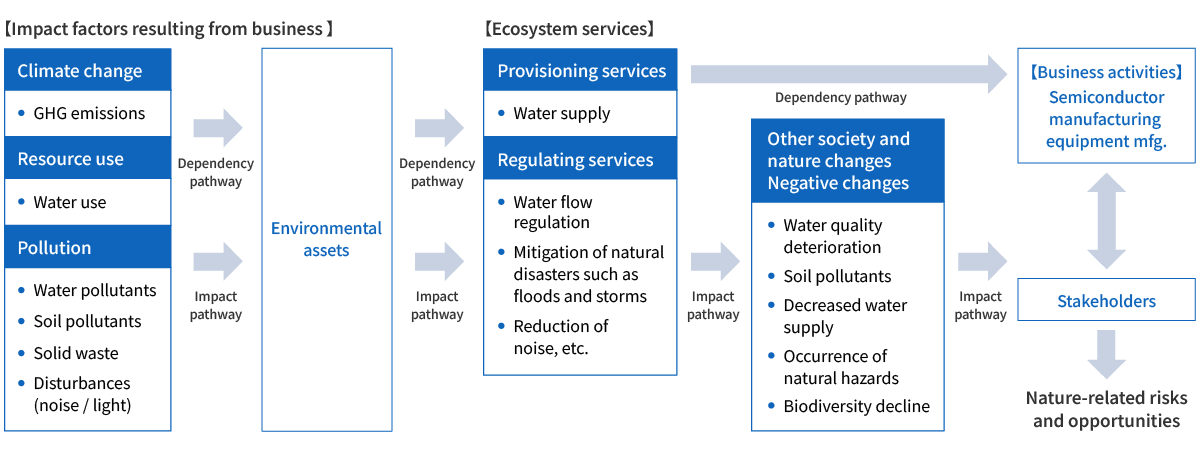
The substantial freshwater withdrawals and the use of specialised gases and chemical substances in Our Group’s semiconductor equipment manufacturing and process evaluation pose potential impact pathways to water quality deterioration, air pollution and subsequent degradation of freshwater and terrestrial ecosystems if not properly managed. To interrupt and mitigate these pathways, Our Group operates abatement systems, water scrubbers and wastewater treatment facilities, and enforces stringent internal standards that exceed national and local regulatory requirements. Regular monitoring is conducted through pollution‑prevention organisations. In addition, to reduce withdrawal‑related impacts, the Toyama site will upgrade its industrial water circulation system in 2025 to purify and reuse process water, increasing recyclable capacity approximately fivefold and thereby minimising negative impacts on natural capital.
Site‑level risk assessment
Using the TNFD LEAP Approach, Our Group conducted geographic screening for its six direct manufacturing and development sites with tools such as IBAT*3 and Aqueduct*4 to assess biodiversity importance and water‑related risks.
The screening indicated that, while water stress levels are generally low across sites, all six locations are situated within 50 km of Key Biodiversity Areas (KBAs)*5, confirming their ecological significance. To ensure disclosure completeness and robust risk management, Our Group designated all six direct sites as priority areas for detailed evaluation of dependencies, impacts, risks and opportunities.
- *3
-
IBAT (Integrated Biodiversity Assessment Tool) provides access to geospatial biodiversity datasets including the IUCN Red List, protected area data (WDPA/Protected Planet) and Key Biodiversity Areas (KBAs).
- *4
-
Aqueduct — the Water Risk Atlas — is used to assess and visualise regional water risks across physical (quantity/quality), regulatory and reputational dimensions.
- *5
-
Key Biodiversity Areas (KBAs) are regions contributing significantly to global biodiversity persistence.
| Site name | Country | Aqueduct | IBAT | |
|---|---|---|---|---|
| Water risk | Threatened species count (IUCN/IBAT, within 50 km) | KBAs | ||
| Yokohama Technology Center | Japan | Low–Medium | 2,374 | 8 |
| Tonami Manufacturing Center | Japan | Low–Medium | 1,205 | 10 |
| Kamiichi Manufacturing Center | Japan | Low–Medium | 1,202 | 4 |
| Toyama Technology & Manufacturing Center | Japan | Low–Medium | 1,198 | 9 |
| Kokusai Electric Korea Co., Ltd. (Head Office, Main Factory) | Korea | Low–Medium | 946 | 2 |
| Pyeongtaek Factory | Korea | Low–Medium | 970 | 5 |
Assessing Risks and Opportunities
Over future time horizons, Our Group identified potential risks and opportunities by applying the TNFD illustrative four‑quadrant scenarios — a 2×2 matrix combining ecosystem service degradation with market/non‑market alignment — to prioritise plausible outcomes. We focused scenario analysis on the scenario judged to have the greatest potential impact on our business (“Go fast or go home”) to enable targeted assessment.
| TNFD’s default nature-risk scenarios |
|
|---|
| TNFD’s default nature-risk scenarios |
|
|---|
| Scope of analysis |
The following six directly managed sites accounted for approximately 70% of Our Group’s revenue in 2024. |
|---|
| Time horizons for nature-related scenarios |
Short term: up to 2030 Medium term: up to 2040 Long term: up to 2050 |
|---|
| Highest‑impact category |
Go fast or go home |
|---|---|
| Expected future environment and impact on Group business |
|
Identifying Risks and Opportunities
Our Group identified and evaluated nature‑related risks and opportunities in accordance with the TNFD taxonomy — classifying physical risks (acute and chronic) and transition risks (policy/regulatory, market, reputational). Through cross‑departmental analysis we assessed interdependencies and impact severity, identifying nine priority nature‑related items and documenting corresponding responses and estimated financial impacts on a three‑tier scale (small/medium/large).
